


Walk into most conversations about green laning and someone will tell you that you need a big adventure bike. A 1200cc machine with panniers, crash bars and a screen tall enough to hide behind. For a first bike, that's usually the wrong advice.
Why lighter beats bigger for a first bike
A green lane doesn't care about horsepower. It cares about balance, ground clearance and how quickly you can put a foot down when the surface shifts under you. A heavy adventure bike is a fine tool once you've got the skills to manage its weight on rutted clay or loose stone, but it's a poor teacher.
Lighter bikes are easier to pick up when you drop them, and on technical ground you will drop it. They're more forgiving of small mistakes, because a slower, lighter machine gives you more time to correct a slide or a wandering front wheel than a heavy one travelling at the same speed. They're also cheaper to insure, cheaper to service and cheaper to repair if you clip a rock or drop it on a rut.
None of this means big adventure bikes have no place on a green lane. Plenty of experienced riders take them out and manage them well. It means a first bike doesn't need to be one.
The criteria that actually matter
Forget badge and power output. These are the things worth checking before you buy.
- Ground clearance. Ruts, rocks and raised roots will find the underside of a low bike quickly. More clearance buys you more margin for error.
- Wheel size. Larger front wheels, 19 or 21 inch, roll over obstacles more easily than an 17 or 18 inch road-biased wheel. This matters more on rutted or rocky lanes than most riders expect.
- Seat height. A bike you can't confidently flat-foot, or close to it, is a bike you'll fight on uneven ground. Confidence at a standstill translates directly into confidence moving.
- Fuel range. Some green lanes are a long way from the nearest petrol station, and a lane can easily eat more fuel than the same distance on tarmac. A smaller tank isn't a dealbreaker, but know your range and plan around it.
- Tyre availability. An unusual wheel size or a bike that only takes expensive, hard to find tyres becomes a genuine inconvenience once you're changing tyres regularly for different conditions. Common sizes keep this simple.
A shortlist across price points

This isn't a list of specific models to buy, it's a set of categories worth looking at, and each one has genuine strengths for a first green laning bike.
- Small-capacity trail bikes (125cc to 250cc). Light, cheap to run, forgiving, and genuinely capable on the kind of easy to moderate lanes most beginners start on. Not fast on the road, but that's rarely the point on a green lane.
- Older enduro bikes. Secondhand enduro machines from the last fifteen to twenty years are often lighter and more capable off-road than anything comparable new, and they come at a fraction of the price. They need a bit more mechanical sympathy and tolerance for road manners that aren't great, but as a green lane tool they're hard to beat for the money.
- Mid-weight adventure bikes (roughly 400cc to 700cc). A genuine middle ground. Enough range and comfort for a longer day out, still light enough to manage on technical ground without a fight. Worth considering once you've got some experience under you and want one bike that does everything reasonably well.
Full-size adventure bikes and expedition machines have their place, particularly for long-distance touring that includes some green lanes along the way. As a dedicated first green laning bike, they're rarely the easiest starting point.
"I've watched plenty of riders turn up on a brand new adventure bike and spend the whole day white-knuckled, then swap onto a mate's old trail bike and relax within ten minutes. The bike doesn't need to be impressive, it needs to be manageable."
— Mat Stuckey, founder of Holloway
The honest truth
The best green laning bike is very often the one already sitting in your garage. If you've got a road bike with reasonable ground clearance and half-decent tyres, or an old trail bike gathering dust, that's a perfectly good place to start. Upgrade once you know what you actually need, not before.
Once you've picked the bike, matching it to the right lane matters just as much. Our guide to tyres for green laning covers how to get the tread pattern right for the ground you'll actually be riding, and our beginner's guide to getting started covers the rest of what you need before your first ride.
Whatever you end up riding, check the lane suits the bike before you commit. Holloway's map shows the difficulty rating and hazards for every legal green lane in England and Wales, free to browse, so you can match the ride to the machine rather than finding out the hard way.
Match the bike, then plan the ride
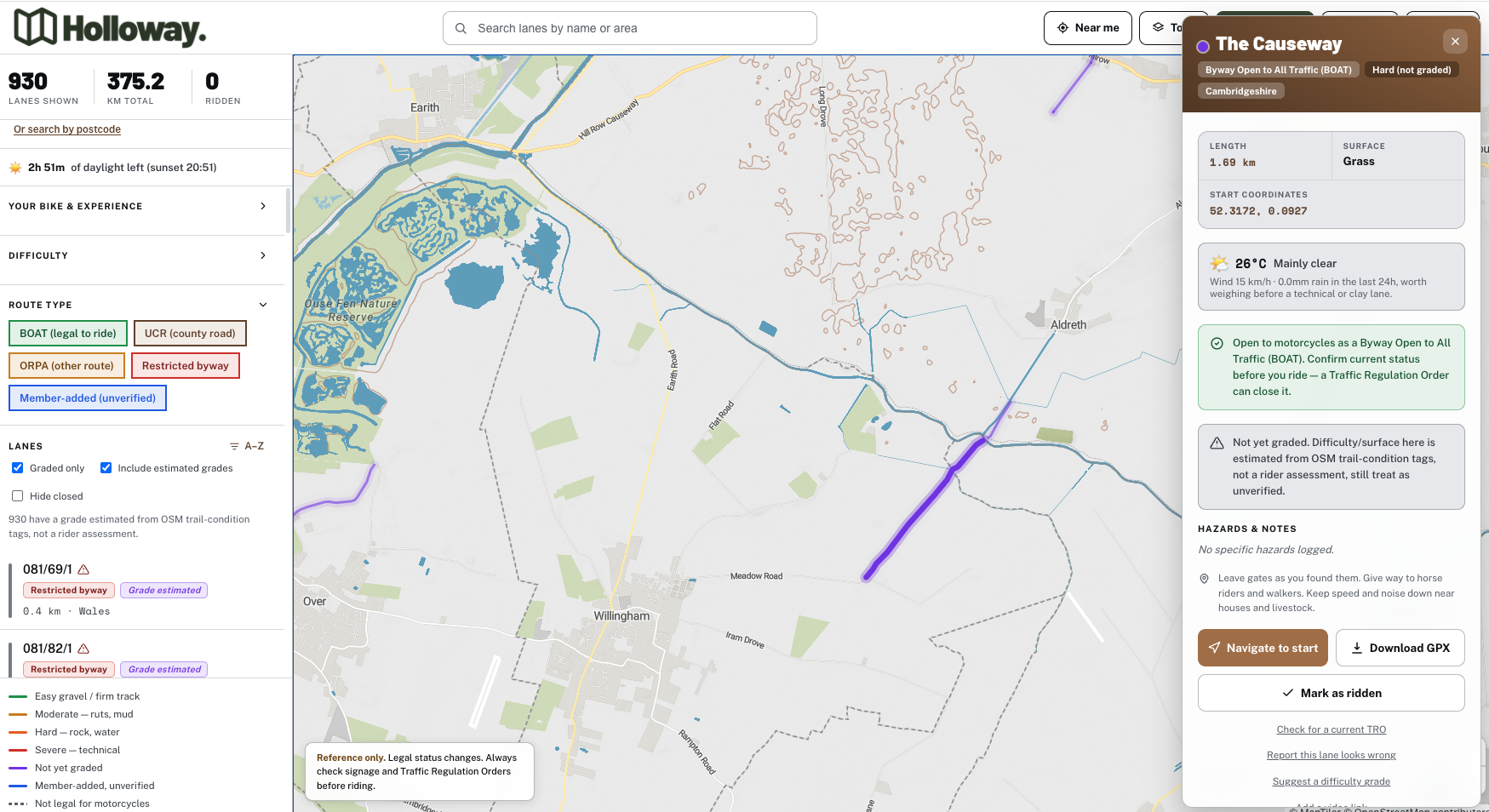
Holloway is a modern, simple tool to find legal green lanes, byways and more across England and Wales, free to use for browsing every legal lane, its classification, difficulty, length and can even help search for the current status. When you're ready to plan a proper day out on whichever bike you've chosen, Holloway Premium, £20 a year, adds full route planning with road-following connectors between lanes, GPX export, exact coordinates and live weather, so you can build the whole route and take it offline.